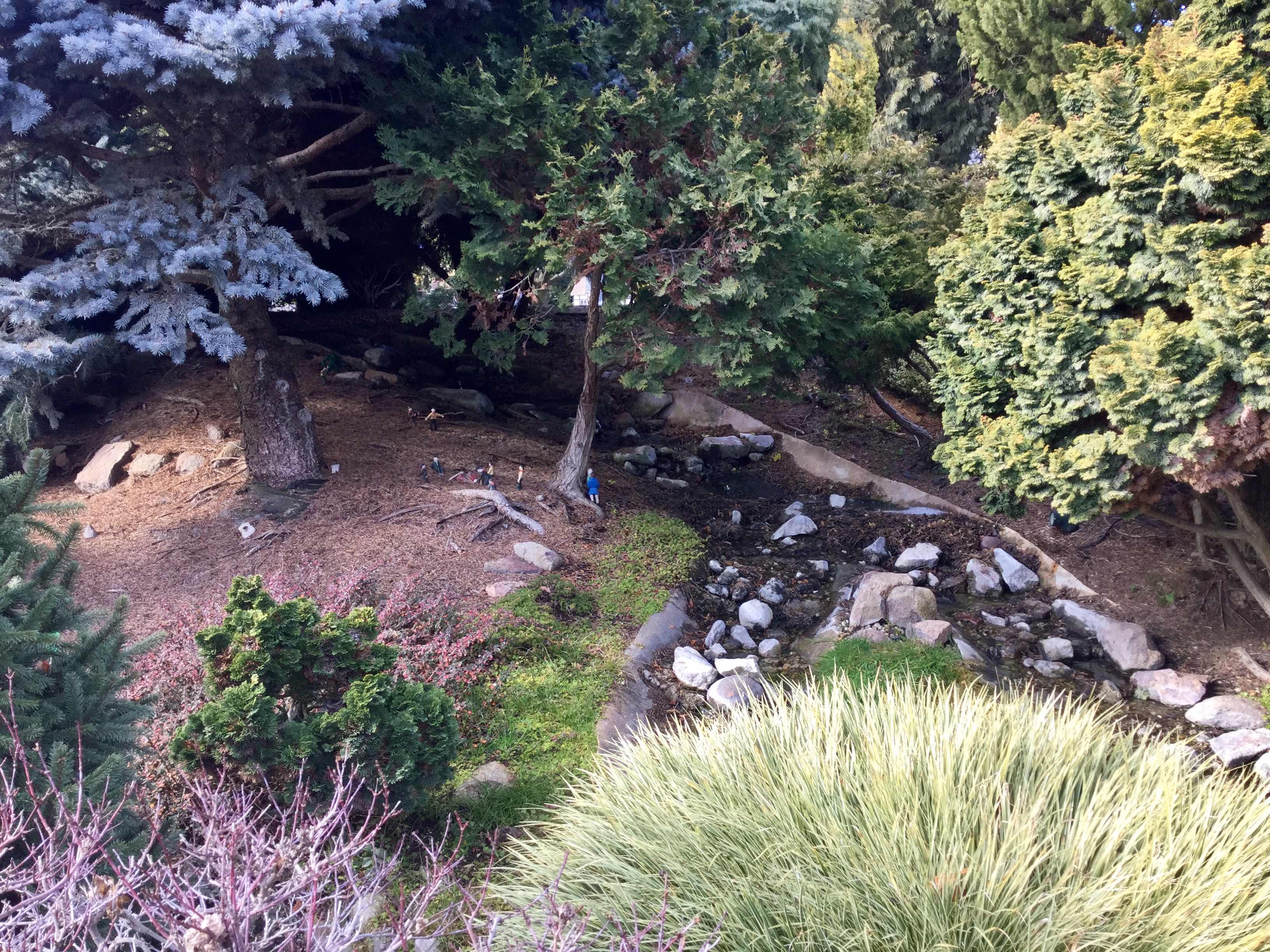
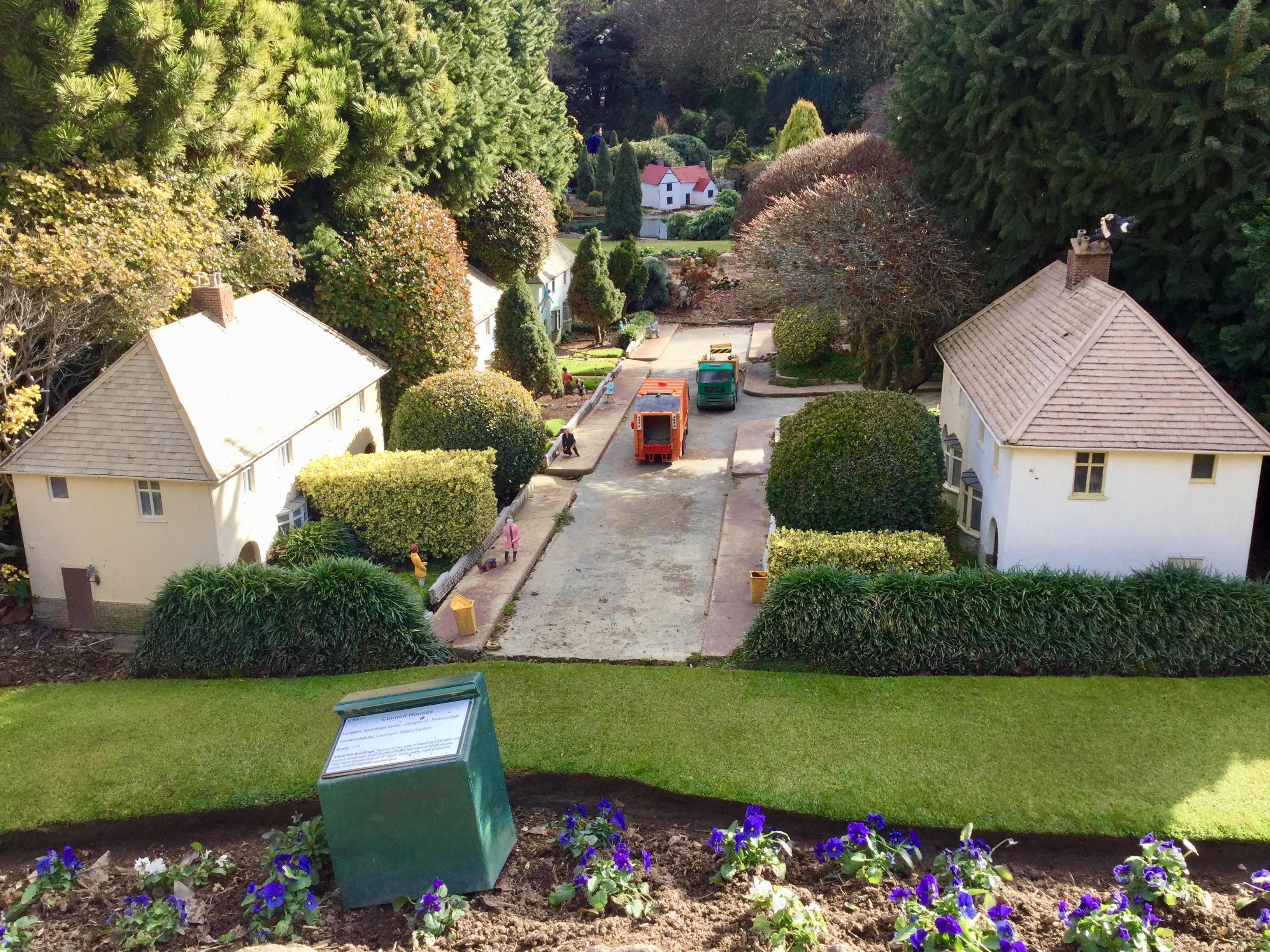
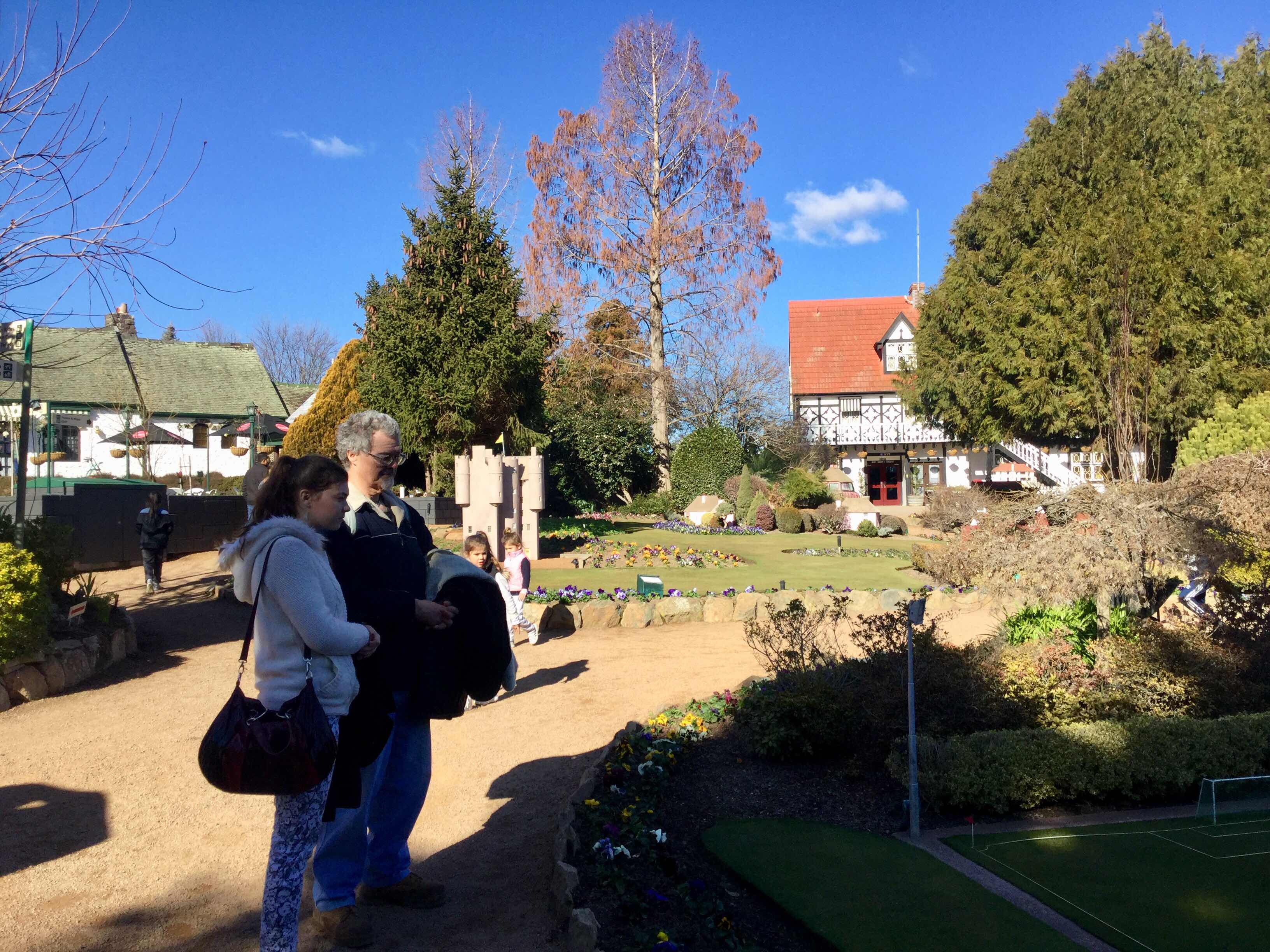
Back in July, on our Canberra, Australia trip, we took two buses to visit Cockington Green. This is situated in one of the outer suburbs of Canberra.
I recommend you go to this tourist attraction. It was so gratifying to see both my family members showing such childlike delight and joy while noticing all the details. It is extremely well done and you don’t need to take anything, unless the weather is showery, then take rain gear. We had a perfect, sunny day in mid Winter, and it doesn’t usually snow there. There are alot of photos, so I’ve broken this post up into parts.
All photos are copyright Runningonempty.
Acerules:
As you go around, you start to notice unusual things, like this Dr Who landing:
See any unusual characters in the stands?
There is a great deal of ongoing maintenance involved in the garden, eg most of the lawns are real! Preparing to mow the lawn:
Acerules with my hubby:
Please come back for part 3!
All photos copyright Runningonempty. We do not own copyright to any art photographed.
"Way down the street there's a light in his place He opens the door, he's got that look on his face And he asks you where you've been You tell him who you've seen And you talk about anything."
Excerpt from Baker Street by Gerry Rafferty
Check out Dan Copping's blog too, congratulations on your 200 th post, Dan, may there be many more!
Guest posted by fellow blogger Dan, with my thanks, is the following explanation:
Brexit: What is it and why did it happen?
The decision of the UK to leave the European Union has filled newspaper columns everywhere. It's had everyone talking, at least that is before Donald Trump took the White House and gave the world something more terrifying to worry about. What is the EU though and why did the UK want to leave it?
For starters, it might be worth a quick explanation of what the UK is. The UK, or the "United Kingdom of Great Britain and Northern Ireland" is a collection of countries (Great Britain being England, Scotland and Northen Ireland) which are also technically countries in their own right. This might seem confusing because they are countries within a country. I tend to think of it like a pair of elastic bands. You can take a smaller elastic band and put it inside a larger elastic band. They're still both elastic bands.
So what is the EU? The EU, or the "European Union" is a group of 28 European countries, who came together just over a decade after the second World War, back in 1957 and decided that it would be better for their economies if they let people live and work anywhere they wanted within those 28 countries. Not only that. The countries also decided that they would trade goods and services with each other as freely as possible, without the kinds of tariffs or extra charges that a country might sometimes add on when it exports and imports goods over its borders.
Something like the EU could never have happened between the US and Russia for example, because relations between the two countries weren't good enough, especially during the Cold War but for all these little countries in Europe, they decided that because they were near each other geographically and already trading a lot between themselves anyway, it would be a lot more efficient to just let the products and people all move between the countries without any costs or delays. That way, everyone could spend more time doing their jobs and selling their products and the countries would prosper more rapidly.
So why does Britain now want to leave the EU?
(Both the UK and Great Britain are commonly just called "Britain", even though one contains Northern Ireland and the other doesn't! This doesn't really make any sense and is more of a language anomaly than anything else.)
(Also, we might often hear people saying "Britain wants to leave Europe". This isn't strictly correct. The country will still be in the continent of Europe, it just won't be part of the European Union.)
After the turn of the century, when countries like Poland and Romania joined the EU, thousands of workers migrated from these poorer countries into the UK in search of higher wages. This led to a perception that the inflow of foreigners was out of control and that something needed to be done about it. Meanwhile, the EU continued to make rules and regulations that impacted the UK, which disgruntled some of the UK's population, who felt that they'd much rather make their own rules than be told what to do by Brussels, which is effectively considered the centre, or the most important city of the EU.
Not all of the UK felt this way. It's worth recognising that a significant majority of the younger population, ie. those under 50 years old, voted to remain in the EU because they didn't really mind about the regulations and they also realised that despite the migration of foreigners into the country, unemployment was still relatively low and the freedom to trade with other EU countries was still an important feature of doing business in the UK and attracting investment from other countries. There is another reason that might have caused the vote to leave the EU though.
We tend to think of the UK as being quite a wealthy country and indeed this is true but it also has a high degree of inequality, meaning there's still a large gap between the incomes of the rich and the poor. Larger than in many other wealthy countries. This is one of the reasons that so many people voted to leave the EU. The poorer people were feeling distanced from the rest of the country and wanted a solution. They wanted to be noticed.
When the 'leave' campaign came along with it's powerful marketing and media coverage, it was attractive to the poorer and older people, who didn't care as much about the overall wealth of the country. They were feeling hard done by. Fed up of the rich people getting ahead. They wanted something to change and voting for Brexit seemed like a good way of shaking things up. "Let's close our borders to the rest of the world and focus on making Britain really British again like it used to be".
A balanced viewpoint is one that looks not just at the weary older citizens who felt like they wanted more control of their country and not just at the fresh young graduates who yearned for the benefits of an integrated continent but at both sides. How they got to the decision and why they voted the way they did.
On the other side of the Atlantic, as the US tries to curb immigration and place tarrifs on trade with China, it's becoming apparent that the UK isn't the only country trying to isolate and protect itself. Nevertheless, the fundamental global trends of technological growth and the surge in information and electronic communications that mark the 21st century remain irreversible. In the long run, it will be up to all countries, regardless of the moods and opinions of their constituent voters, to try to try to trade and accommodate workers as efficiently as possible, if we are to maximise global production and standards of living into the future.